
Checking Criminal History in New Hanover County
No single search returns every New Hanover County criminal record. Start with the event you need to prove. The North Carolina eCourts Portal is the first stop for a prosecution, while the sheriff's P2C service answers current or recent county-custody questions. The Court Dates tool supplies future settings, not a complete history. For your own fingerprint-linked North Carolina record, use the SBI Right to Review process.
Gather a full name, spelling variants, an approximate event date, and any case or booking number. Match a result by court location, charge, agency, and date rather than name alone. Then confirm the current outcome with the record's custodian.
- Choose court, booking, agency-report, supervision, registry, or personal-review records based on the question.
- Search the official portal with the narrowest reliable fields.
- Compare several non-sensitive details before treating a match as the right person.
- Open the case, booking, or profile and note its source date and status.
- Ask the clerk, sheriff, police agency, SBI, or NCDAC for verification when the result will be relied on.
New Hanover Criminal Record Routes
New Hanover County records move between offices, but each office keeps a distinct product. An officer writes the report. Detention staff create a booking entry. A magistrate records the first appearance and release terms. Prosecutors decide what to file, and the Clerk of Superior Court maintains the District or Superior Court case. Fingerprint-supported arrest data and later dispositions move to SBI. NCDAC begins at state custody or community supervision.
| Question | First channel | Best fallback |
|---|---|---|
| Filed charge or outcome | eCourts Portal | Clerk at Princess Street |
| Current county custody | Sheriff P2C Inmate Inquiry | Detention front desk |
| Officer narrative | Arresting agency records unit | Focused written request |
| State prison or supervision | NCDAC Offender Locator | Responsible field office |
| Own statewide history | SBI Right to Review | SBI exception process |
That chain explains why a new booking may appear before a court file and why an SBI cycle can temporarily lack a disposition. A portal gap is a cue to check the next custodian, not proof that nothing exists.
North Carolina Official Background Checks
The North Carolina State Bureau of Investigation does not offer the public an instant name-search portal. Its official self-review product is the fingerprint-based Right to Review. It covers North Carolina arrest fingerprint cards and matched dispositions received by SBI. It does not cover other states, and SBI returns the response to the subject by first-class mail.
A New Hanover County resident completes the packet, gets a full set of ten rolled fingerprints, adds certified funds, and mails the request. SBI lists a processing period of up to 20 business days. The New Hanover County Sheriff's Office offers fingerprinting by appointment through its Permits Unit. Authorized statutory agencies follow separate access rules; those channels are not a general public name check.
| Official product | Base fee | Coverage and limit |
|---|---|---|
| SBI Right to Review | $14 | Subject's fingerprint-supported North Carolina history; mail only |
| FBI Identity History Summary | $18 | Subject's FBI-held national history; current fingerprints required |
| New Hanover court search | Free online inspection | Local and statewide case dockets, not a rap sheet |
New Hanover SBI Record Review
The SBI personal-review page shows the official path for checking your own state record.
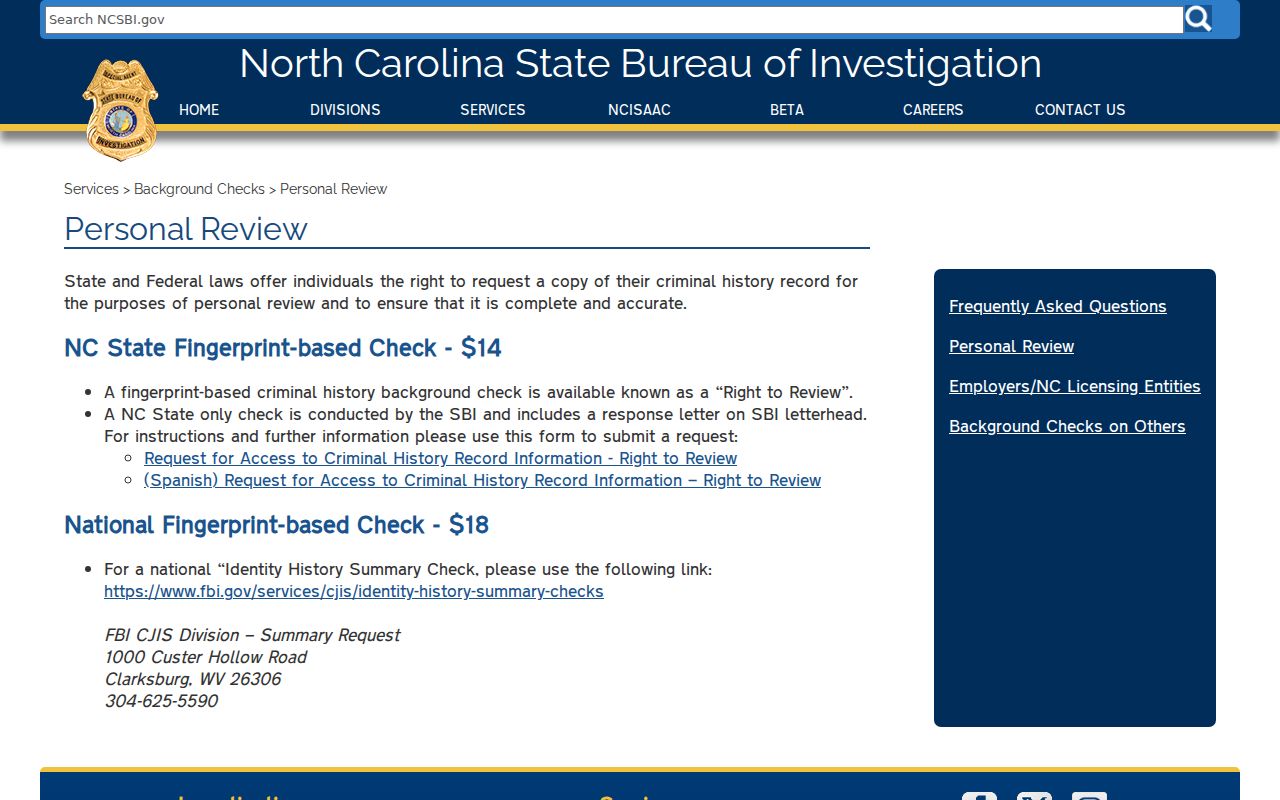
The process is deliberately tied to fingerprints, not a loose name match. The packet requires identifying and mailing information, signature, payment, and a completed fingerprint card. SBI accepts a money order or certified check, but not cash, credit cards, or personal or business checks. Direct in-person delivery is prohibited.
If your own result seems wrong, first compare it with the New Hanover County clerk's certified disposition. SBI's exception process accepts written challenges and supporting court records. A missing outcome can be a reporting or matching gap, so the court file is the key evidence.
Criminal Record Types
New Hanover County agencies create records at different points. Police and sheriff incident reports describe the complaint and investigation. An arrest report states the legal basis and arrest charges. The Castle Hayne detention intake file focuses on booking, property, custody, photo, fingerprints, bond, and release. None alone proves a conviction.
- Court files: pleadings, hearings, disposition, judgment, sentence, costs, and certified copies held by the clerk.
- SBI history: fingerprint-linked arrest cycles and reported outcomes held in the state repository.
- Warrant records: judicial process tracked through courts and law enforcement, with some unserved or sealed details restricted.
- NCDAC records: state incarceration, probation, parole, and post-release supervision, not county jail custody.
- Registry profiles: statutory public information maintained statewide with local sheriff verification.
The best record is the one built for the question. A booking entry shows custody. A case file shows what prosecutors filed and how the court acted; the New Hanover County criminal court case guide explains that docket in depth. A fingerprint history connects statewide cycles when SBI received the prints and disposition.
New Hanover P2C Record Grid
The sheriff's Police-to-Citizen portal is New Hanover County's main self-service route for inmate, event, report, bulletin, and wanted-list functions.
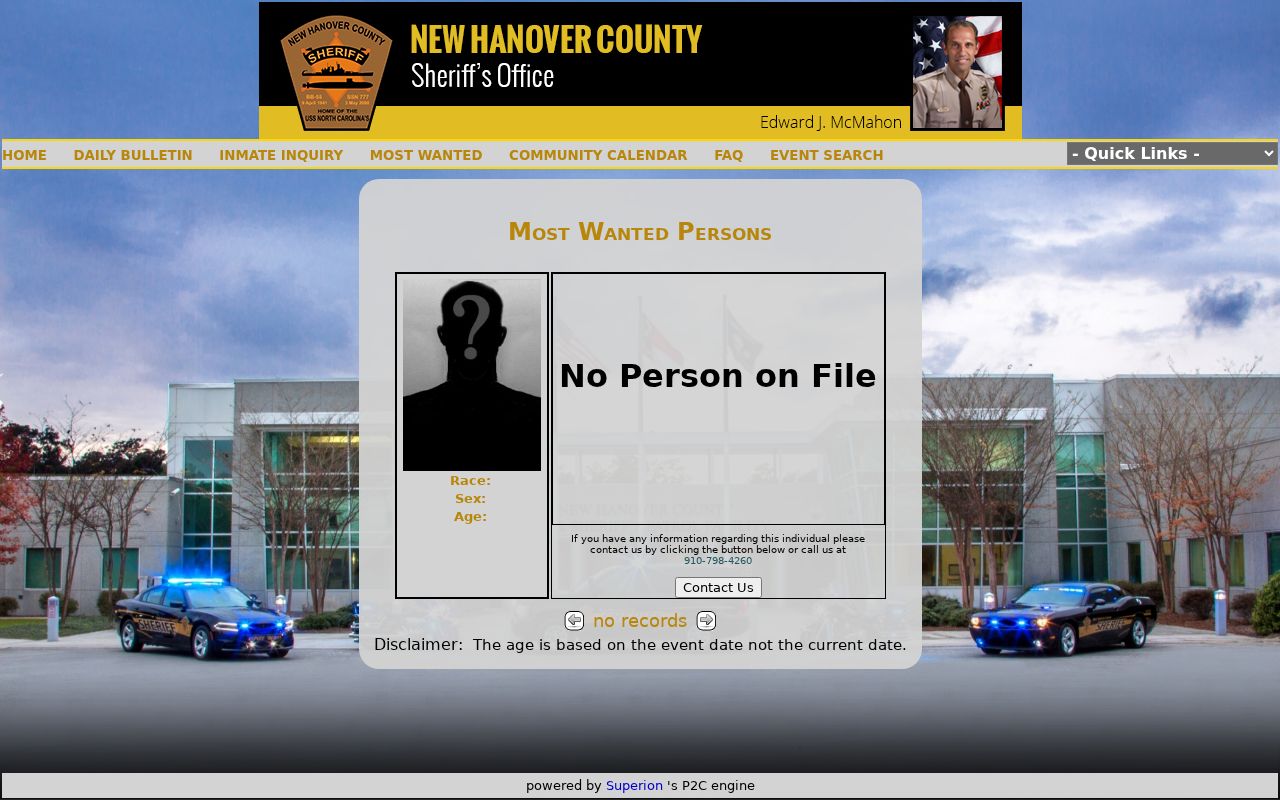
The Most Wanted screen is curated and incomplete. It is not a real-time certification that a warrant exists or has cleared. A person resolving their own possible warrant should call the sheriff at 910-798-4200 or the clerk and magistrates at 910-772-6600 and 910-772-6619. Do not approach anyone based on a list entry.
P2C Inmate Inquiry is more exact about current county custody. Its grid displays Name, Primary Charge, Arrest Date, and Booking Agency. Advanced filters include name parts, race, sex, age, primary charge, date, and agency. The list does not promise bond, housing, warrant number, release date, or court date. Call the 24-hour booking operation when the displayed fields do not answer the question.
The sheriff's Daily Bulletin is another event-level source, but it should not be read as a full criminal history. Its activity entries can help narrow a date or agency before a focused request. For a possible warrant tied to your own case, use the phone chain instead of relying on the Most Wanted list: the sheriff can address law-enforcement status, while the clerk or criminal magistrate can check court-issued process. Legal advice can help plan a safe resolution.
Inside a New Hanover County Criminal Record
A New Hanover County criminal record must be read in context. A rap sheet begins with identifiers and groups fingerprint-linked arrest cycles. A court case adds procedural detail. A booking file adds custody detail. Common names can produce false matches, and a missing disposition does not mean the charge is still pending.
| Name and identifiers | Legal name, aliases, birth details, physical descriptors, state ID, and sometimes FBI number. |
|---|---|
| Arrest and booking | Agency, arrest date, charges, booking number, intake and release data, and custody status where public. |
| Charges and statutes | Charge descriptions, offense codes, level or class, and separate counts. |
| Disposition | Dismissal, acquittal, conviction, plea, or other recorded outcome with a date. |
| Sentence | Confinement or suspended term, probation, fine, costs, restitution, and judgment details. |
| Supervision status | NCDAC prison, probation, parole, or post-release information after sentencing. |
For a filed New Hanover County case, compare the case number, court location, filing date, charge, status, and disposition. Document images can be more restricted than docket metadata. Certified copies come from the clerk.
New Hanover Custody Record Lines
The New Hanover County Detention Facility is a 672-bed jail with an estimated 6,000 to 7,000 bookings each year. It sits at 3950 Juvenile Center Road in Castle Hayne, apart from the downtown courthouse. That scale makes its inmate grid a fast-changing custody snapshot rather than a final case index.
The NCDAC Offender Public Information Search begins at a later stage.
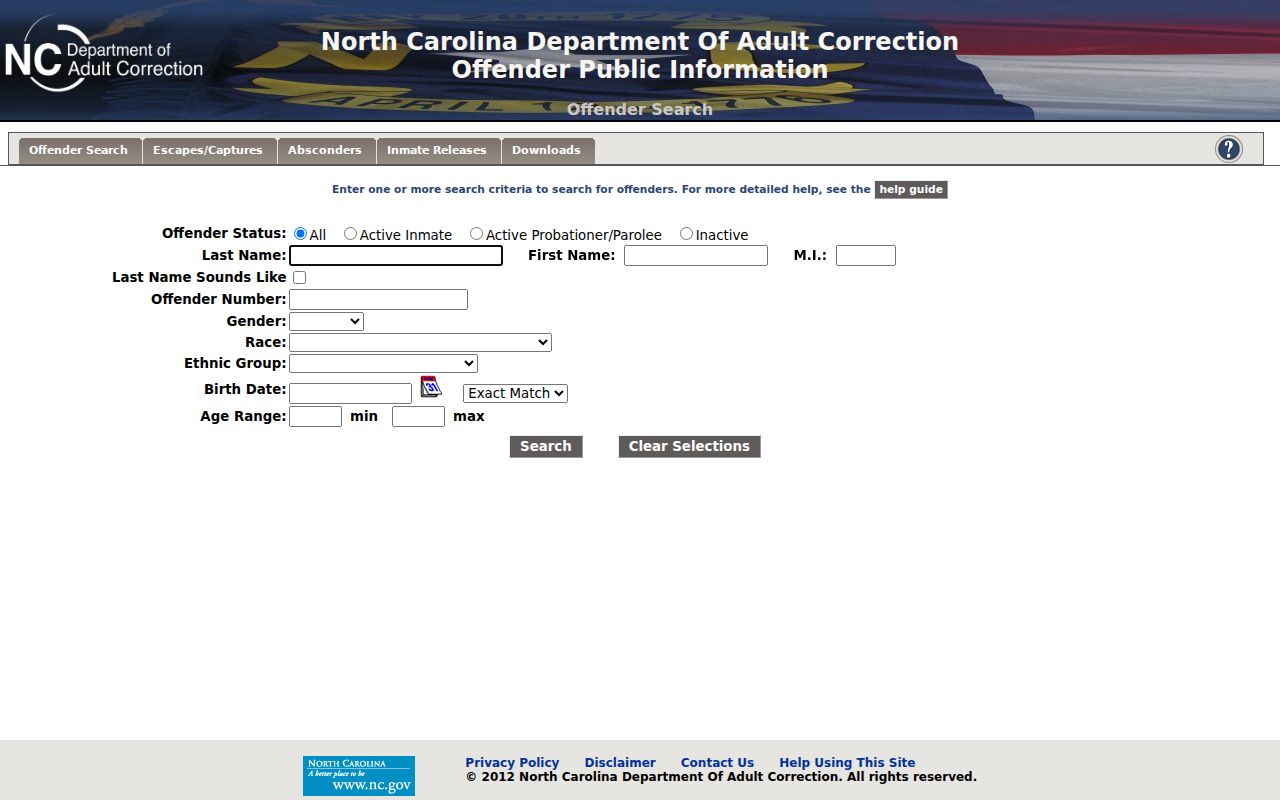
NCDAC covers state prison and community supervision history back to 1972 and expressly excludes county-jail inmates. NC SAVAN can provide custody notifications. Use the sheriff's inquiry for the county jail, NCDAC after transfer or sentencing, and the clerk's judgment to explain the legal basis for the change.
Note: A person may leave the jail roster before the New Hanover County court case reaches final disposition.
Public Access Laws in North Carolina
North Carolina access turns on the custodian and record type. The general Public Records Law does not make every police narrative open. Clerk-held records usually begin under court-record access law. Criminal investigation records follow a more specific rule. Juvenile, victim-identifying, sealed, expunged, medical, and security-sensitive material may be withheld or redacted.
Key North Carolina laws:
G.S. 132-1 broadly defines public records, subject to exceptions.
G.S. 132-1.4 sets special rules for criminal investigation and specified arrest information.
G.S. 7A-109 opens clerk-maintained records to inspection unless another law restricts them.
G.S. 15A-151 limits access to confidential expunction files.
G.S. 14-208.10 makes covered registry information public under Article 27A.
A focused request works best. Name the creating agency, describe the record, give a tight date range, and include an incident, case, or booking number when known. Ask separately for an incident report, arrest report, booking sheet, detention log, or 911/CAD item because those are different products.
New Hanover Courthouse Record Access
The New Hanover County Courthouse is the main public counter for District and Superior Court criminal files.
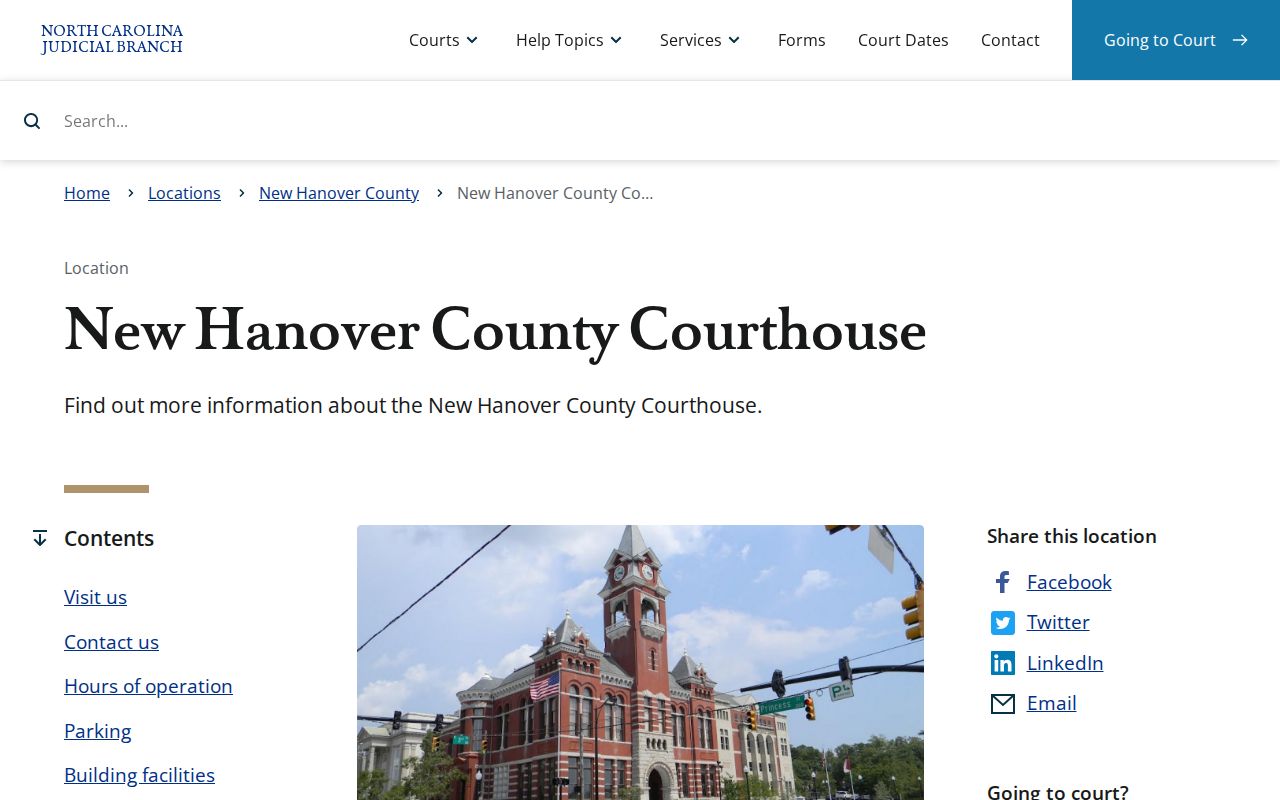
The clerk is at 316 Princess Street, Wilmington, NC 28401, and the counter is open weekdays from 8 a.m. to 5 p.m. Call 910-772-6600. One Clerk of Superior Court maintains both District and Superior Court files because North Carolina uses a unified state court system. District Court handles misdemeanors and felony preliminary stages; Superior Court is the chief felony trial court.
Clerk of Superior Court
316 Princess St.
Wilmington, NC 28401
910-772-6600
Weekdays, 8 a.m. to 5 p.m.
Sheriff and Detention
3950 Juvenile Center Road
Castle Hayne, NC 28429
910-798-4200
Booking operates 24 hours
District Attorney
316 Princess St., Suite 543
Wilmington, NC 28401
910-772-6610
Weekdays, 8:30 a.m. to 5 p.m.
A public eCourts kiosk added for New Hanover County in June 2025 gives courthouse users access to a scanner, printer, and payment tools when home equipment is not enough. The clerk remains the authoritative source for certified court material. A certified New Hanover County name search is a separate $25 clerk product, while free portal inspection is a case search rather than a certified county history or an SBI rap sheet.
Sealed, Expunged, and Restricted Records
North Carolina uses the term expunction. Eligibility is tied to the exact charge, outcome, age, prior history, and waiting period. Routes include some dismissed or not-guilty charges and certain eligible nonviolent convictions. Some offenses are excluded. Match the current Judicial Branch form and statute to the New Hanover County case rather than relying on a broad checklist.
File through the New Hanover County Clerk of Superior Court because the case arose here. A petition may call for case and charge data, affidavits, verification, service on the District Attorney, and record checks. Fees vary by the legal route. An indigent filer can ask about a Petition to Proceed as an Indigent.
After an order, updates do not reach every system at once. Check the court docket first. If your fingerprint record still appears wrong, obtain an SBI Right to Review and send the exception unit the certified expunction order. A Certificate of Relief under G.S. 15A-173.2 addresses some collateral consequences but does not erase the case.
Second Chance Wilmington provides another local route for people reviewing their own relief options. Legal Aid of North Carolina reports that the program supports expunction and driver-license restoration services in New Hanover County through September 2026. Program help does not replace the case-specific statute, petition form, or clerk filing, but it can help a person sort the records and court steps before filing.
New Hanover Criminal Record Geography
Ports, beaches, a university, and a dense county seat place several agencies within compact New Hanover County. Wilmington Police, Carolina Beach Police, Wrightsville Beach Police, Kure Beach Police, UNCW Police, State Highway Patrol, airport and ports officers, park rangers, and the sheriff can each create an incident or arrest report. The agency that wrote the report remains its custodian even when the sheriff performs the booking.
Federal matters use a separate record path. The Eastern District of North Carolina's Wilmington court is at 2 Princess Street. For community-safety research, use the separate New Hanover County sex offender search and its official registry channels.
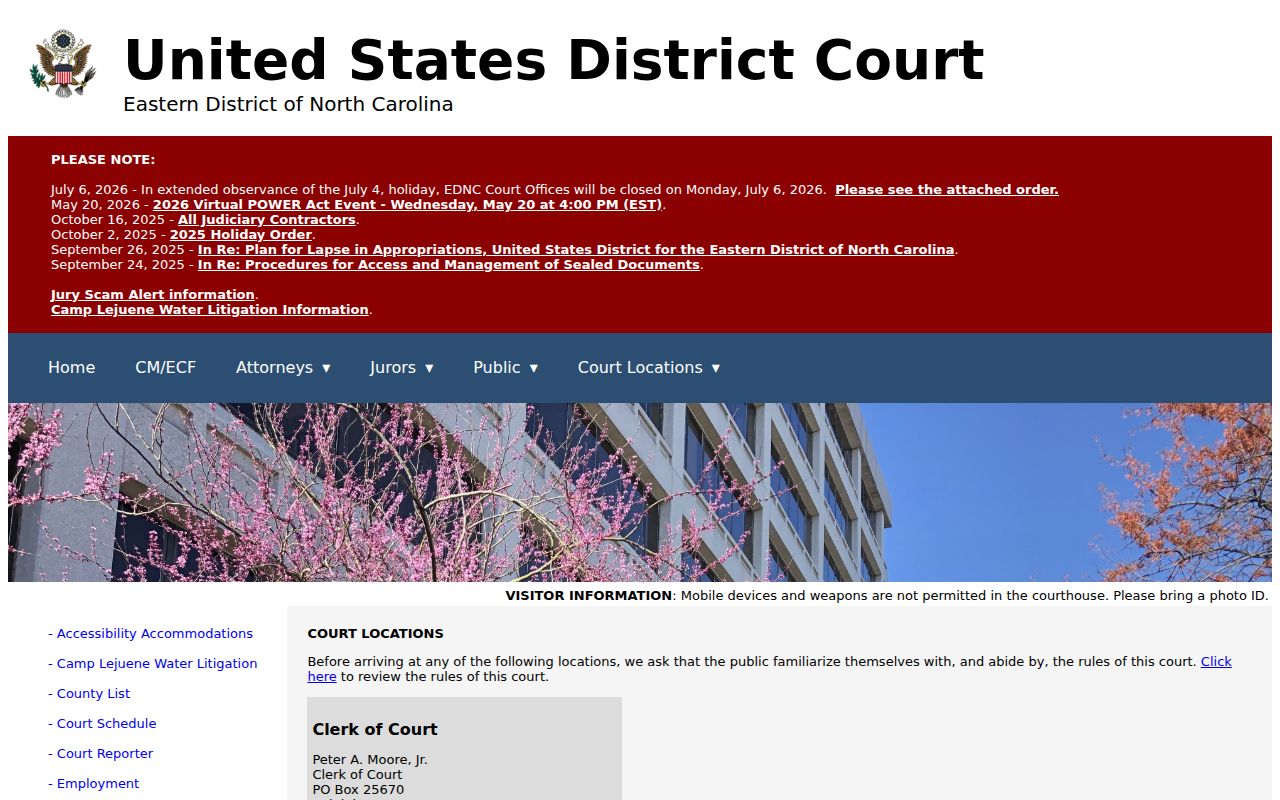
Federal dockets are in PACER, not the New Hanover County clerk's system. Entry rules ban mobile devices and weapons. The Federal Bureau of Prisons locator covers federal custody, while NCDAC covers state custody and the sheriff covers the county jail.
New Hanover Federal Inmate Records
The Federal Bureau of Prisons inmate locator provides the federal custody layer for cases tied to New Hanover County.
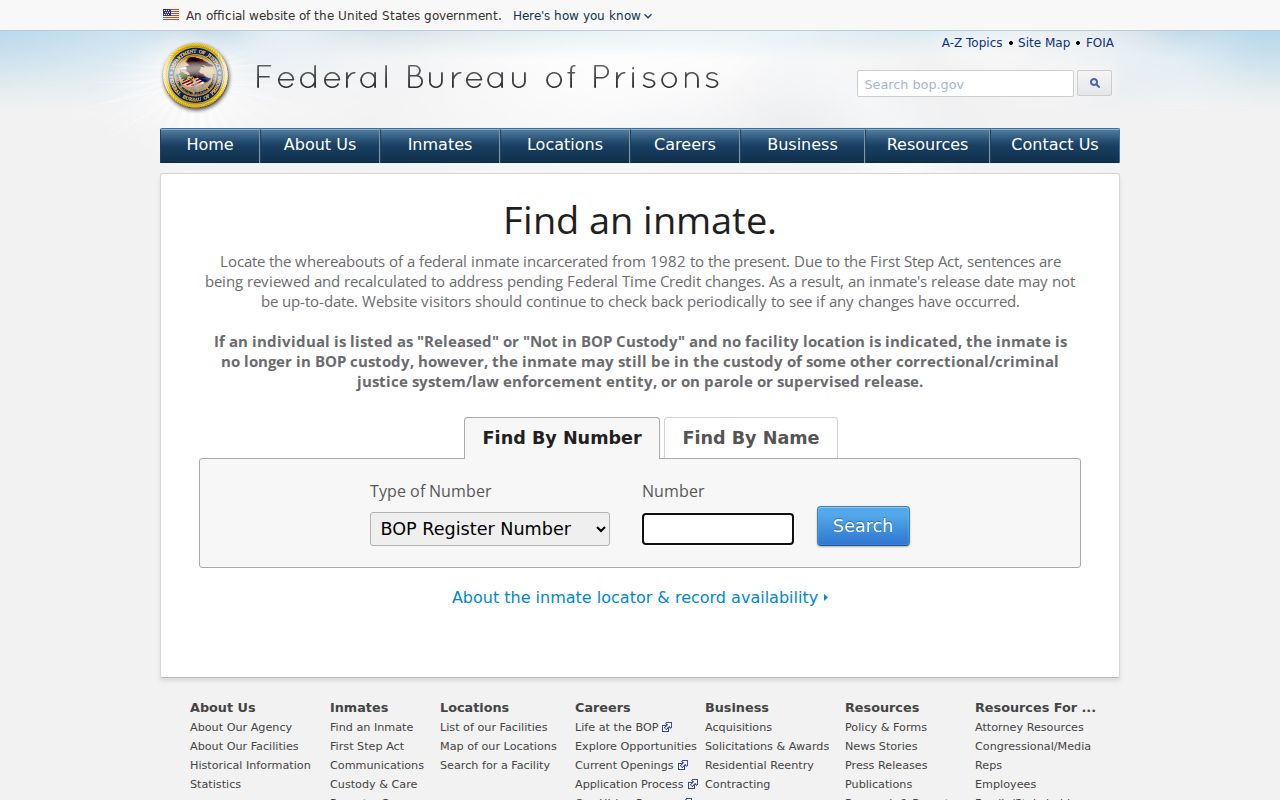
The locator is not a substitute for the sheriff roster or the NCDAC search. It covers people in federal custody, not someone held only at the Castle Hayne facility. For the case itself, PACER is the official docket channel. For your own national fingerprint history, the FBI Identity History Summary is the proper product.
Use the court and custody systems together. A federal docket explains charges and disposition. The BOP result answers incarceration questions. Neither supplies a New Hanover County police narrative, and neither should be read as an SBI state record.
New Hanover County Criminal Records by City
Wilmington, Carolina Beach, and Wrightsville Beach are New Hanover County's three largest incorporated places. Their police departments retain agency reports, yet criminal cases all enter the same unified North Carolina District and Superior Court system. Custodial arrests generally move to the county detention facility. Start with the city agency for its report, the sheriff for booking, and eCourts for the filed case.
Wilmington Criminal Records
Population 115,451 · WPD P2C reports, county booking, and unified county courts
Carolina Beach Criminal Records
Population 6,564 · Town police records and eCrash, with county booking
Wrightsville Beach Criminal Records
Population 2,473 · Town report channels and temporary holding before county transport
There are no separate city criminal courts. Kure Beach ranks fourth and does not receive a city page under the project population rule, but its police department remains the custodian of reports it creates.