
Checking Criminal History in Carolina Beach
A Carolina Beach records search works best when it starts with the event, not a broad name query. The Carolina Beach Police Department creates the local incident, arrest, and crash report. A custodial arrest then produces a separate New Hanover County booking entry, while any prosecution becomes a District or Superior Court case. The SBI repository is a fourth system and does not offer a public, instant name search.
Gather the full name, event date, street or landmark, report number if known, and the type of copy needed. Those details help the police records staff distinguish a crash report from an incident file and help the clerk find the right court case.
- Ask Carolina Beach Police which local report exists and whether it is ready for release.
- Use the accident portal only for a crash. Request crime and incident reports from the station by phone, fax, mail, or in person.
- Check Sheriff P2C Inmate Inquiry when the question is current or recent county custody.
- Search the North Carolina eCourts Portal for the filed charge, hearing trail, and disposition.
- Use SBI Right to Review by mail when reviewing your own fingerprint-supported North Carolina history.
Carolina Beach eCrash Record Limits
The town's official eCrash channel serves accident reports. It is not a portal for crime reports, arrest histories, warrants, or jail entries. That distinction can save a wasted search. A collision report begins with CBPD, but a criminal incident must go through the police records channel described by the town.
The official eCrash portal image below shows why its scope should be read before entering search details.
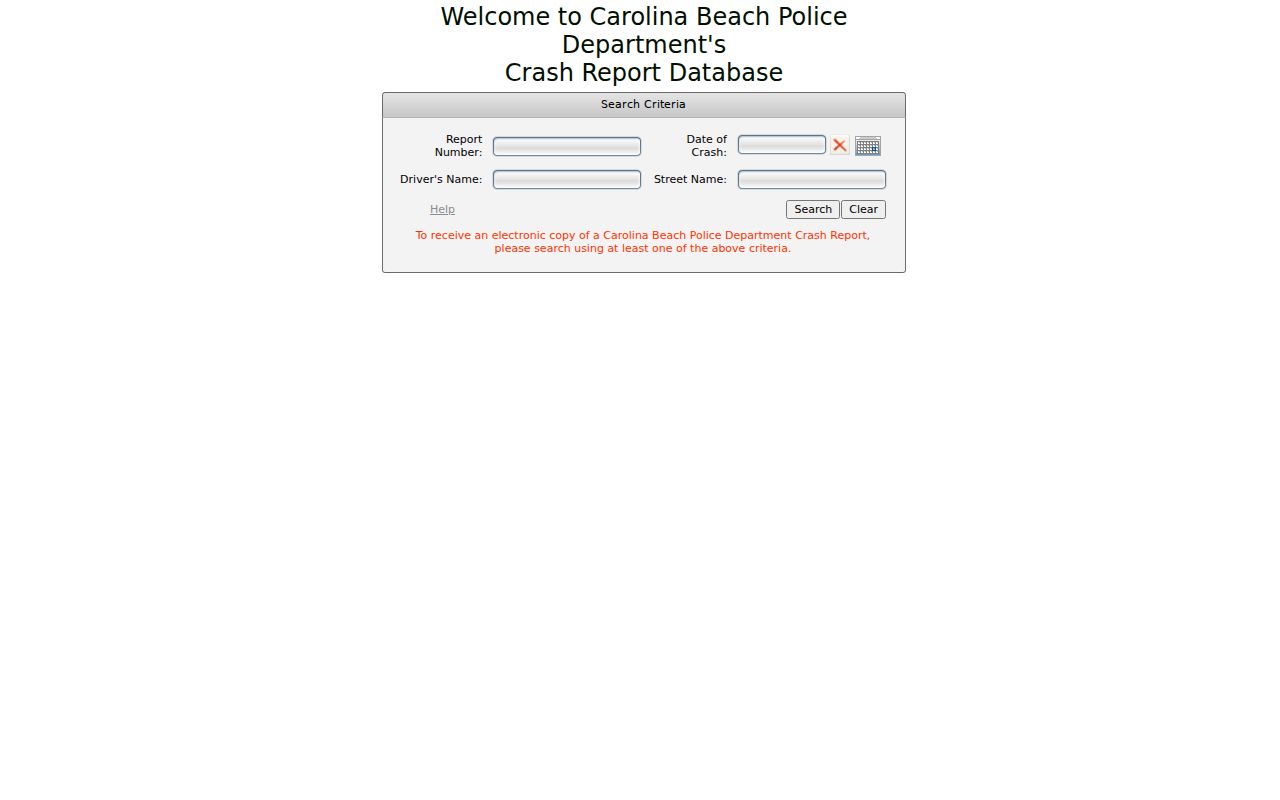
The screen is useful for a crash record, while all other Carolina Beach police records require direct contact with the department.
An accident report also should not be treated as a criminal case file. It may document drivers, vehicles, location, and the officer's crash findings without showing a criminal charge or court outcome. If the crash led to an arrest, use the report number to ask CBPD for the proper agency record, then check county booking and eCourts separately. That sequence keeps the accident search from being stretched beyond what the eCrash product was built to show.
Carolina Beach Police Department Records
Carolina Beach Police is at 1121 North Lake Park Boulevard, Carolina Beach, NC 28428. Police service runs around the clock, while the front desk is open Monday through Friday from 8:00 a.m. to 5:00 p.m. The main number is 910-458-2540, the fax is 910-458-2988, and nonemergency dispatch is 910-452-6120. The anonymous tip line is 910-458-1246.
The agency holds the officer-created record. Ask for a crash, incident, offense, or arrest report by its correct name. Give the date, location, involved name, and report number if one is known. The county jail can confirm a booking, but its intake entry does not replace a Carolina Beach officer's narrative or evidence record.
The town's official police contact image shows the local office that receives these report questions.
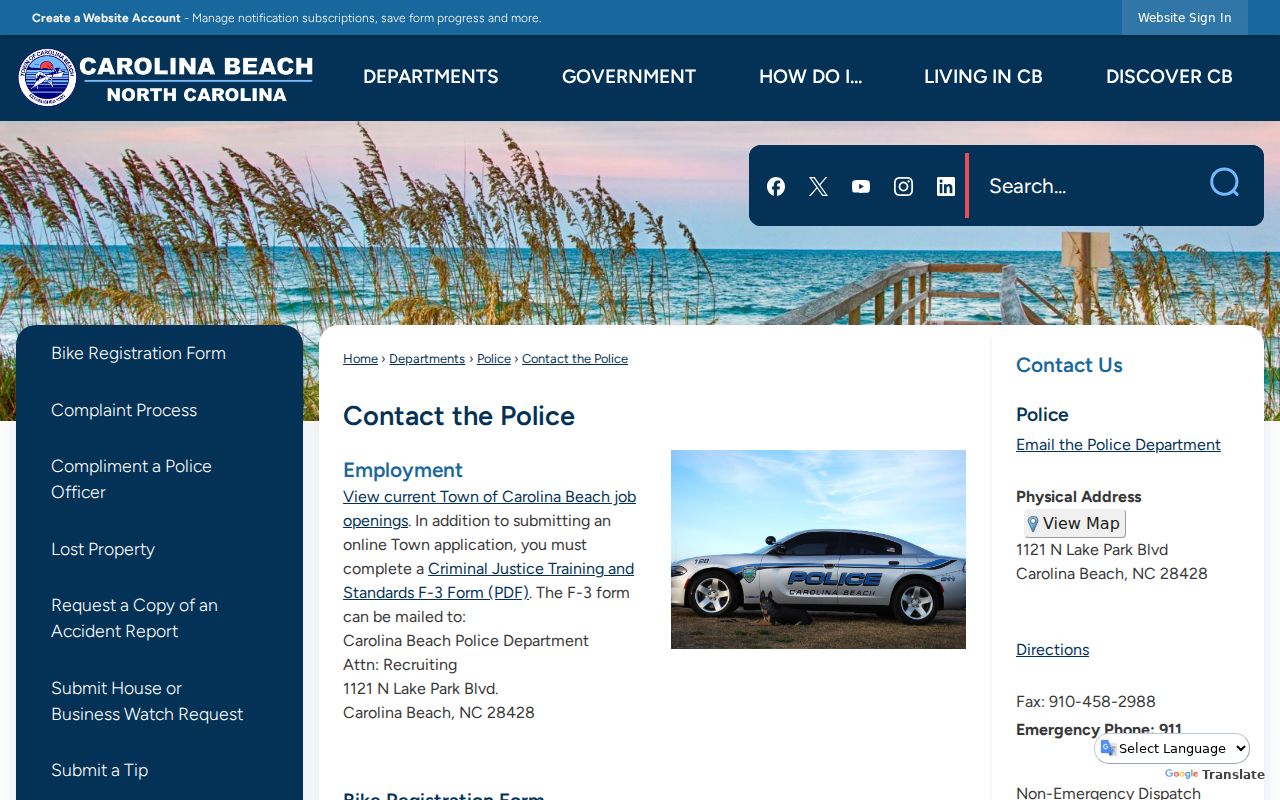
Calling records before a trip helps confirm that the requested public copy has been approved and prepared.
Carolina Beach Report Wait Times
Carolina Beach tells requesters to allow up to ten days for an accident report. The delay is one reason to call before going to the station. A report may still be under review, incomplete, or held while the officer finishes required work. A same-day custody question should instead go to the sheriff's inmate system because booking is a separate, faster-moving record.
For a crime event, the initial public report and the investigative file may have different release status. North Carolina law allows specified incident and arrest information to be disclosed while treating criminal-investigation records as a special class. Ask what can be released now and whether another portion may become available once the investigation is closed or inactive.
Note: A ten-day crash window does not set the release time for every Carolina Beach police record.
Carolina Beach Arrests and Bookings
Carolina Beach has no separate city jail roster. After a custodial CBPD arrest, booking occurs at the New Hanover County Detention Facility in Castle Hayne. The sheriff's P2C Inmate Inquiry is the right starting point for recent custody. Its public list can be filtered by name and may show the primary charge, arrest date, and booking agency.
A booking charge is an accusation recorded at intake. It can differ from the charge a prosecutor later files. Search the eCourts Portal after checking custody, then compare the case number, filed charge, court level, status, and disposition. If no P2C match appears, call the detention front desk at 910-798-4200. Request the officer's report from CBPD, since the arresting agency remains its custodian.
Mailing Carolina Beach Record Requests
The town's official report instructions allow crime or incident report requests through the station, by phone or fax, or in writing. A mailed request should include a self-addressed stamped envelope. State the exact record sought, the event date and location, an involved name, and the case or report number when available. A focused request gives staff less to clarify.
The official report-instruction image below captures the Carolina Beach request methods and release timing.
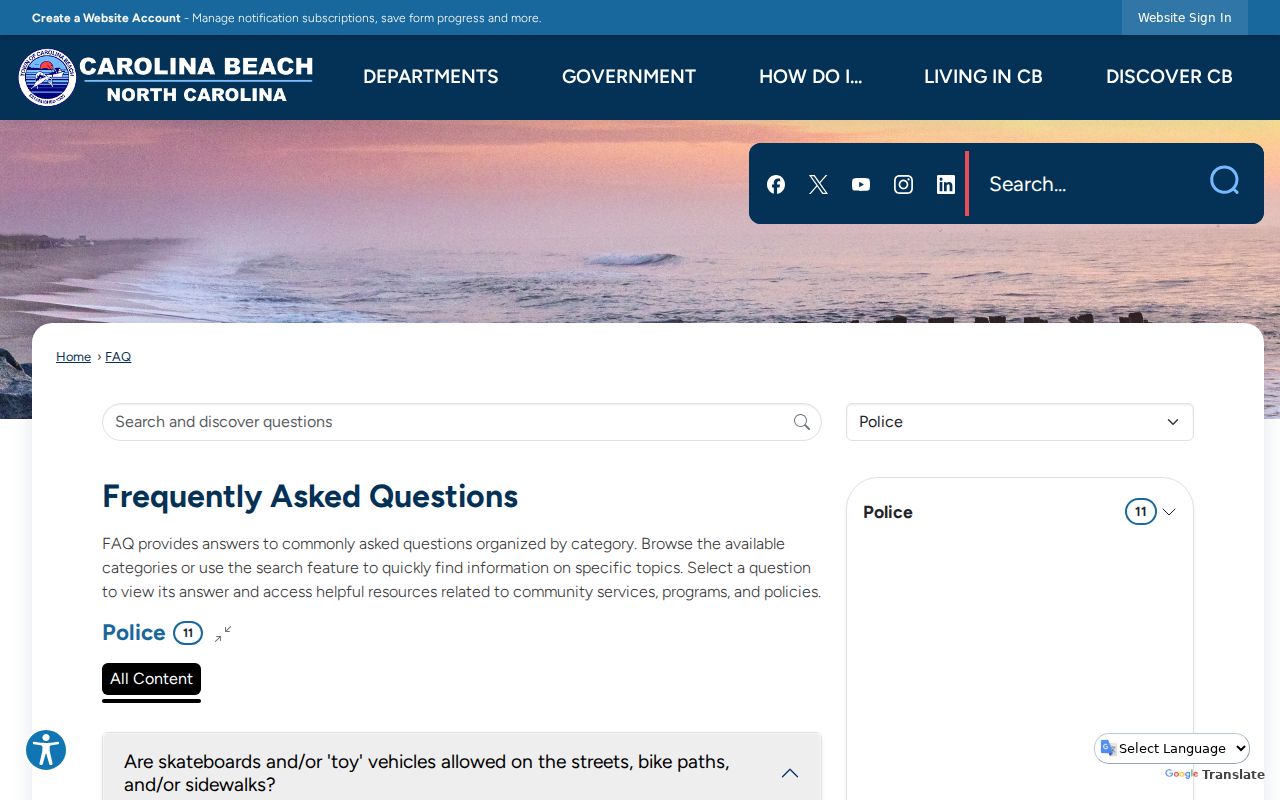
Those instructions also support a call-first approach, which avoids travel before an approved copy is ready.
Do not combine unrelated demands into one vague request. A crash report, officer narrative, booking sheet, 911 item, and court judgment come from different systems. Name the Carolina Beach police item first, then contact the county custodian for records created after transport or charging. An out-of-town requester can still use the same focused format. Include a mailing address, phone or email for clarification, and the preferred delivery method. If a paper copy is requested, the stamped return envelope supports the town's stated mail process. Avoid sending more personal data than staff need to locate the incident. A close date range and exact location often do more useful work than a broad narrative.
Municipal Court Records in Carolina Beach
Carolina Beach does not operate a municipal criminal court. Misdemeanors, infractions, and felony preliminary matters go through New Hanover County District Court. Felony trials are heard in Superior Court. One Clerk of Superior Court keeps both levels of criminal files at the courthouse in Wilmington, so a search for a local prosecution belongs in the state court system rather than a town docket.
| Court Name | New Hanover County District Court or Superior Court, based on the case level |
|---|---|
| Case Types Heard | District Court handles misdemeanors, infractions, traffic, and felony preliminary stages; Superior Court tries felonies |
| Case Lookup Channel | North Carolina eCourts Portal, Court Dates, and the Clerk of Superior Court counter |
| What the Docket Shows | Case number, charges, events, hearings, status, disposition, and public financial entries when available |
| Copies & Fees | The clerk supplies document inspection and certified copies; confirm the current charge for the requested product |
The clerk's file is the best source for how a Carolina Beach charge ended. A town report can establish what police recorded, but only the court record shows a dismissal, plea, verdict, judgment, or other disposition.
Carolina Beach Visitor Report Exception
Carolina Beach ordinarily expects reports to follow its established police process, but the town expressly recognizes that an out-of-town visitor may need a telephone-report exception. That resort-specific option is handled case by case. It is not a broad promise that any police report can be taken by phone. Explain why an in-person report is impractical and let CBPD decide the proper route.
Seasonal travel also affects record interpretation. FBI Crime Data Explorer monthly actuals for 2024 total 22 violent and 127 property offenses reported by CBPD. Those are reported offenses, not arrest or conviction totals. Carolina Beach's small resident population and large visitor load make a simple per-resident comparison misleading. The figures can describe police workload, but not a person's criminal history or a final court result.
Where Carolina Beach Records Go
A Carolina Beach incident starts with the police report. If the event leads to custody, New Hanover County detention staff create the booking file and collect fingerprints. A magistrate addresses the initial appearance and release conditions. The clerk then maintains the criminal prosecution, and reported fingerprints and later dispositions can be matched in the SBI repository.
Record flow: Carolina Beach Police Department › New Hanover County Courts › North Carolina State Bureau of Investigation
The timing will not always line up. A sheriff booking can appear before an eCourts case, and a fingerprint cycle may lack the outcome until the clerk's disposition is reported. Follow the event from the town report to county custody and then to the filed case. For more depth on the judicial file, use the New Hanover County criminal court case search.
Carolina Beach Fingerprint Appointments
Carolina Beach offers public fingerprinting by appointment during a Wednesday window from 10:00 to 11:00 a.m. The published charge is $20 for Carolina Beach and Kure Beach residents and $40 for nonresidents. Calls and prisoner processing can affect the window, so confirm the appointment before arrival.
Fingerprints serve a different purpose from the town report search. For a North Carolina personal criminal-history review, the subject completes the SBI Right to Review packet, obtains a legible ten-finger set, and mails the form, prints, and $14 certified funds to SBI. SBI returns the state-only result by U.S. mail. It is not a same-day city or county search.
Carolina Beach Police Record Context
Carolina Beach's public record trail sits in a town shaped by tourism and storms. The official Boardwalk history dates the resort to 1887 and incorporation to 1925. A major fire in 1940 led to the “South's Miracle Beach” reopening, Hurricane Hazel struck in 1954, and modern revitalization began in 2008. Those facts help explain why historic town material and today's digital police records do not form one seamless archive.
For a modern criminal event, use the current custodian chain. CBPD holds the agency report, the sheriff holds county booking, and the clerk holds the prosecution. Historical research may call for town archives or older paper files, while a present court outcome should be verified through the clerk. Do not treat a Boardwalk history source as a criminal docket or a current police database.
Public Access Rules in Carolina Beach
North Carolina access law turns on the custodian and record type. Ordinary public records begin under Chapter 132, but police investigative files have distinct treatment. Clerk-maintained court records generally remain open to inspection unless another law restricts them. Juvenile, victim-identifying, sealed, expunged, medical, and security-sensitive content may be withheld or redacted.
Key Statutes:
N.C. Gen. Stat. § 132-1 broadly defines public records, subject to statutory exceptions.
N.C. Gen. Stat. § 132-1.4 gives criminal-investigation and specified arrest or incident information special rules.
N.C. Gen. Stat. § 7A-109 opens clerk-maintained court records to inspection unless law provides otherwise.
Ask CBPD for the city report and the clerk for the court record. A denial or redaction of investigative detail does not mean the public docket is also closed, and an open docket does not force police to release every narrative or item of evidence.