
New Hanover County Criminal Court Cases
New Hanover County criminal cases do not sit in separate city court databases. North Carolina uses a unified state court system. District Court hears misdemeanors, traffic matters, and the early steps in felony cases. Superior Court is the main felony trial court. New Hanover County is in District Court District 6, Superior Court District 6, and Prosecutorial District 6.
The Clerk of Superior Court maintains the files for both court levels. That office keeps the docket, filed charging papers, orders, judgments, financial entries, and certified copies. It does not hold an officer's narrative report or the sheriff's booking file. Those records remain with the arresting agency or detention staff. Wilmington, Carolina Beach, and Wrightsville Beach have no separate municipal criminal courts, so their prosecutions also feed into the New Hanover County court file.
New Hanover District and Superior Courts
The court level helps explain what appears in a New Hanover County criminal case. District Court handles misdemeanors and traffic cases from filing through disposition. It also conducts preliminary felony proceedings. A felony may later move to Superior Court after indictment or another lawful charging route. Searchers should not treat an early District Court entry as the final location of every felony file.
At the clerk's counter, give the defendant's name, case number if known, and the division: District Criminal, Superior Criminal, or Criminal Traffic. The courthouse directory also separates criminal division contacts. Criminal magistrates handle initial appearances and bond functions, while the District Attorney reviews and prosecutes charges. Each office takes part in the case, but the clerk remains the public custodian of the judicial record.
Searching New Hanover County Case Records
The official North Carolina eCourts Portal is the first remote channel for New Hanover County case records. Use the separate Court Dates search when the question is limited to an upcoming appearance. A calendar is not a complete docket, and portal metadata may not include a viewable copy of every filed document.
- Open eCourts Smart Search and enter a party name or case number in the main search box.
- Expand the advanced filters, then select New Hanover County or the matching court location.
- Narrow the result to criminal case categories and a useful filing or activity date range.
- Open the likely match and compare the case number, filed date, charges, status, hearings, and disposition.
- Ask the Clerk of Superior Court for document inspection or a certified copy when the portal is incomplete.
Common names can return several cases. Confirm a match through multiple non-sensitive fields instead of relying on a name alone.
New Hanover eCourts Search Filters
Smart Search starts broad, then lets a user apply filters. Controls can change as the vendor updates the portal, but the inspected fields below show the practical search path for New Hanover County criminal court cases.
| Field or Control | Type | Required | Use |
|---|---|---|---|
| Search | Text | Yes | Party name or record/case number |
| Advanced Filtering Options | Expandable | No | Opens narrower controls |
| Location | Dropdown | No | Select New Hanover County when available |
| Case type/category | Dropdown | No | Limits results to criminal categories |
| Date range | Date controls | No | Narrows filing or activity dates |
| Search / Reset | Buttons | Search only | Runs or clears the query |
The official North Carolina Court Dates page illustrates the statewide calendar channel used for New Hanover County settings.
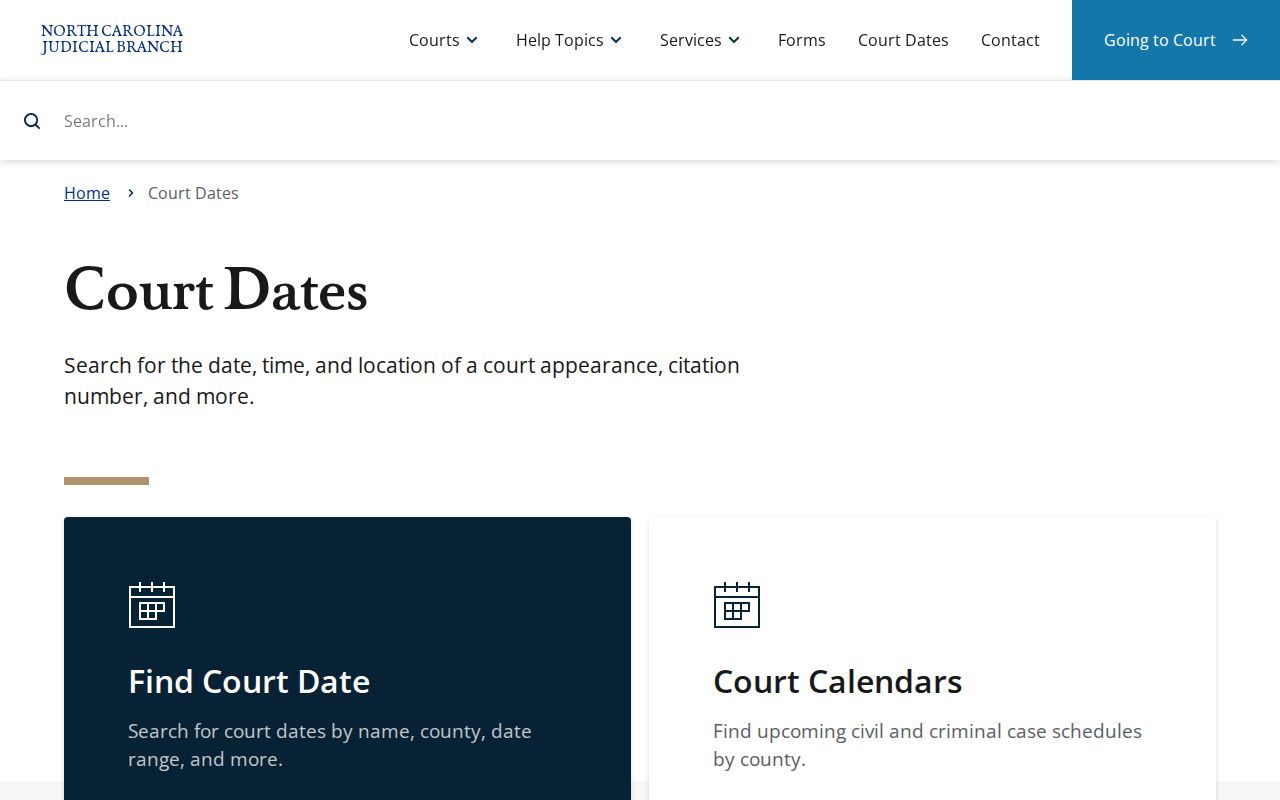
That tool helps locate a scheduled hearing, but the eCourts docket and clerk's file supply the fuller procedural history.
Inside a New Hanover County Case File
A New Hanover County case file follows the prosecution rather than the jail stay. It can show which charge was filed, how that charge changed, what the judge ordered, and how the matter ended. Document images may be less open online than docket metadata.
| Case Number & Court | Identifies the New Hanover County location, case type, filing, status, and assigned judicial officer when shown. |
|---|---|
| Parties & Attorneys | Lists the State of North Carolina, the defendant, and counsel when entered. |
| Charges | Shows description, statute or offense code, level or class, and count sequence. |
| Docket Events | Records filings, first appearance, indictment, arraignment, motions, hearings, plea or trial, and judgment events as applicable. |
| Disposition | States a dismissal, not guilty finding, conviction, prayer for judgment continued, or another recorded outcome and date. |
| Sentence & Financials | May show confinement, a suspended term, probation, costs, fines, restitution, and public payment entries. |
| Documents & Redactions | May expose metadata without an image; sensitive identifiers and protected victim or minor data are restricted. |
New Hanover Case Events and Outcomes
A charge is not the outcome. Read the newest disposition entry and its date, then look for a judgment. An arrest charge may differ from the count the prosecutor files. It may also be amended, dismissed, resolved by plea, or tested at trial.
- Arraignment
- The hearing where charges and a plea are addressed.
- Indictment
- A grand jury's formal felony accusation.
- Nolle prosequi
- The prosecutor declines to proceed on that charge at that time.
- Disposition
- The recorded result of a charge or case.
- Prayer for judgment continued
- A distinct North Carolina outcome that should be read from the actual docket and order.
Note: A missing disposition can reflect a reporting or matching gap, so confirm the New Hanover County clerk's file before drawing a conclusion.
How a Criminal Case Moves
The judicial case begins once charges are filed. A first appearance and bond record may come first, followed by pretrial settings and motions. Misdemeanors can remain in District Court. A felony commonly has early District Court steps before Superior Court proceedings. Not every New Hanover County criminal case reaches trial, and the research does not support a fixed time for each stage.
Case flow: Charges Filed › Arraignment › Pretrial › Plea or Trial › Disposition › Sentencing
The disposition and judgment are the key final entries. A sentence may include active confinement, a suspended term, probation, costs, a fine, or restitution, depending on the judgment.
New Hanover Treatment Court Paths
Some eligible District 6 matters follow a more specialized record trail. Community Empowerment Court brings together a judge, prosecutor, defense, treatment provider, probation officer, and treatment-court coordinator for people with mental-health needs. Teen Court diverts eligible juvenile nonviolent matters, but juvenile records remain confidential. A youth alcohol deferred-prosecution track can also use education, service, and other terms.
The Prosecutorial District 6 office describes its local role and programs. Its public material provides useful context, but the District Attorney is not the court-record custodian.

For any program-linked case, use the clerk's docket to determine the actual filed events and final outcome.
Princess Street Criminal File Access
The New Hanover County Courthouse is at 316 Princess Street, Wilmington, NC 28401. It is open weekdays from 8:00 a.m. to 5:00 p.m., and the clerk's main number is 910-772-6600. Older files, remotely restricted material, and document-level questions may require a public terminal or counter visit. New Hanover County was also included in the 2025 rollout of courthouse eCourts kiosks with scanners, printers, and payment services.
Clerk of Superior Court
316 Princess Street
Wilmington, NC 28401
910-772-6600
Weekdays, 8:00 a.m. to 5:00 p.m.
Ask for the correct New Hanover County criminal division and state whether plain inspection or a certified court record is needed. A certified copy comes from the clerk, not from a screen capture.
A certified New Hanover County name search is a separate $25 clerk product. It should not be confused with free eCourts inspection or with SBI Right to Review. The portal locates case metadata, the clerk certifies its own court material, and SBI uses fingerprints for a subject's statewide repository history.
Case Record Access & Restrictions
N.C. Gen. Stat. §7A-109 generally makes clerk-maintained records open to public inspection unless another law provides otherwise. That rule does not make every record fully visible online. Juvenile matters, expunged files, victim and minor information, sensitive identifiers, and security-related material can be confidential, sealed, or redacted.
Law-enforcement narratives follow a different rule. N.C. Gen. Stat. §132-1.4 treats criminal investigation records differently from court dockets. Request the officer's report from the agency that created it, not from the clerk. If an expected New Hanover County case does not appear remotely, ask whether the file is older, restricted from remote view, under another case number, or available only at the counter.
New Hanover Expunction Effects
North Carolina expunction is tied to a specific statute and case outcome. It is not one broad sealing process. Dismissals and not-guilty findings may fall under one route, while eligible nonviolent convictions use other rules. A person files through the clerk in the county of the case, which means New Hanover County petitions begin with the Princess Street clerk and the Judicial Branch form that matches the statute.
After an order, notices go to record-holding agencies. Systems may not all update at once. A person checking their own history can compare the court docket with an SBI Right to Review record and use the SBI exception process with certified court proof if a fingerprint history remains wrong. A Certificate of Relief is separate and does not erase the case.